Reichertek Nu:Archive: Imagining the Ultimate Phono Recorder
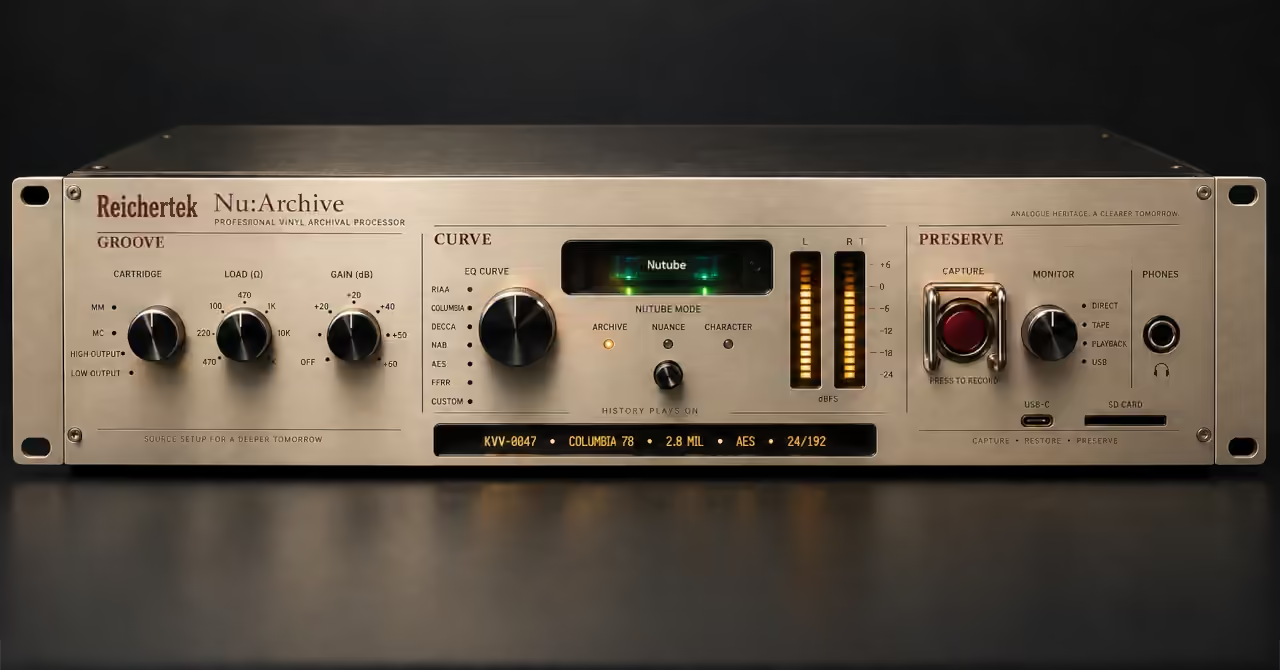
Give every record a future worthy of its past.
Some recordings survive not because they were perfectly preserved, but because someone cared enough to listen again.
The Reichertek Nu:Archive is a professional phono preamplifier and high-resolution archival recorder created for collectors, restoration engineers and musical historians. Designed for everything from modern microgroove vinyl to rare 78 rpm pressings, it brings cartridge control, historical equalisation, precision monitoring and studio-grade digital capture together in one purposeful 2U instrument.
Nu recognises that preservation and presentation are different acts. Its transparent Archive path captures the record as faithfully as possible, while the adjustable Nutube stage introduces the harmonic character required for a sympathetic listening master. Both versions can be created during the same playback: one as evidence, the other as interpretation.
Selectable RIAA, AES, NAB, Columbia, Decca and custom curves allow recordings to be heard in their proper historical context. Flexible mono and channel-selection modes help recover the quietest information from worn groove walls, while high-resolution PCM and DSD recording preserve every viable detail for restoration, study and future publication.
Its champagne-aluminium façade is organised around three clear stages; Groove, Curve and Preserve. There are no buried menus between the record and the recording engineer: only deliberate controls, visible metering and an illuminated Nutube quietly at work behind smoked glass.
The Reichertek Nu:Archive is not an accessory for playing old records. It is an instrument for carrying recorded history forward.
Reichertek Nu:Archive specifications
Product type: Professional phono preamplifier and high-resolution archival recorder
Concept specification — Revision 0.1
Nu:Archive is a 2U rack-mounted transfer instrument for vinyl, shellac and other grooved-media recordings. It combines configurable cartridge amplification, historically appropriate replay equalisation, a genuinely bypassable Nutube character stage and computer-independent high-resolution capture.
Operating architecture
- Groove: Cartridge loading, gain, channel selection, phase, rumble filtering and groove-wall recovery.
- Curve: RIAA and historical replay curves, flat capture and user-defined turnover and roll-off values.
- Preserve: High-resolution PCM or DSD recording to computer or SD card, with confidence monitoring and session metadata.
Phono inputs
| Cartridge support | Moving magnet, moving iron, high-output moving coil and low-output moving coil |
|---|---|
| Input connectors | One pair of gold-plated RCA phono inputs with chassis ground terminal |
| Gain | 40, 46, 52, 58, 64 and 70 dB |
| MM loading | 47 kΩ; selectable 50, 100, 150, 220, 320 and 470 pF capacitance |
| MC loading | Selectable 10, 30, 50, 100, 220, 470 Ω and 1 kΩ |
| Subsonic filter | Off or 15 Hz, 18 dB/octave |
Channel and restoration controls
| Channel modes | Stereo, mono sum, left groove wall, right groove wall and difference |
|---|---|
| Phase | Independent left- and right-channel polarity reversal |
| Balance | ±6 dB calibrated cartridge and groove-wall balance |
| Monitoring | Source, processed return and recorded-file confidence monitoring |
| Markers | Front-panel insertion of track, event and restoration markers during capture |
Replay equalisation
| Factory curves | Flat, RIAA, AES, NAB, Columbia LP, Decca/London, EMI, Victor and FFRR |
|---|---|
| Custom curves | User-definable bass turnover and high-frequency roll-off, with 32 recall locations |
| Flat archival mode | Unequalised capture for non-destructive application of replay curves during restoration |
| Accuracy target | ±0.15 dB, 20 Hz–20 kHz against the selected curve |
Nutube character stage
| Device | Dual-triode Nutube 6P1 stage with mechanically isolated mounting |
|---|---|
| Archive | Hard-relay bypass removes the Nutube and its supporting circuit from the preservation path |
| Nuance | Restrained harmonic enrichment for restored listening masters |
| Character | Continuously variable Nutube contribution with level-compensated comparison |
| Dual-master recording | Optional parallel creation of a neutral preservation master and a Nutube-treated presentation master |
Digital recording
| Converter architecture | Independent dual-range stereo ADC pairs serve the isolated Archive and Nutube presentation paths, providing extended capture headroom for both simultaneous masters |
|---|---|
| PCM | 32-bit floating-point BWF or WAV at 44.1, 48, 88.2, 96, 176.4 or 192 kHz; 32-bit float/96 kHz BWF is the default preservation format, with 24-bit PCM available for compatibility |
| DSD | DSF at DSD64 (2.8 MHz), DSD128 (5.6 MHz) or DSD256 (11.2 MHz) |
| Simultaneous masters | Time-aligned stereo Archive and Nutube presentation masters can be recorded during a single playback |
| Destinations | USB-C host computer or SDXC card up to 1 TB |
| Standalone operation | Record, stop, pause, monitor, mark and name sessions without a connected computer |
| Session metadata | Source ID, label, speed, stylus size, replay curve, format, date, operator and signal-path designation |
| Clocking | Internal low-jitter master clock with word-clock input and output on BNC |
Connections and monitoring
| Analogue outputs | Balanced XLR and unbalanced RCA line outputs |
|---|---|
| Headphones | 6.35 mm stereo output with independent monitor level |
| Digital outputs | USB-C audio, AES3 on XLR and coaxial S/PDIF |
| Metering | Dual 24-segment peak meters with peak hold and separate analogue-overload and digital-clip indication |
| Session display | Source identity, stylus, replay curve, recording format and capture status |
Performance targets
| Frequency response | 10 Hz–80 kHz, +0/−1 dB in flat mode at 192 kHz PCM |
|---|---|
| ADC dynamic range | Greater than 118 dB, A-weighted |
| THD+N | Less than 0.003% in Archive mode at nominal level |
| Channel separation | Greater than 90 dB at 1 kHz, excluding cartridge |
Mechanical and electrical
| Format | 2U, 19-inch rack mount with removable rack ears |
|---|---|
| Construction | Steel inner chassis with brushed champagne-anodised aluminium façade |
| Dimensions | 482.6 × 88.1 × 320 mm, including rack ears and excluding connector clearance |
| Weight target | Approximately 6.2 kg |
| Power | 100–240 V AC, 50/60 Hz internal universal power supply |
| Cooling | Fanless convection cooling |
| Finish | Champagne aluminium, oxblood-red engraving, amber metering and smoked Nutube window |
Specification status: Nu:Archive is a conceptual Reichertek product. All dimensions, formats and measured-performance figures are provisional engineering targets requiring confirmation through design, prototyping, compliance testing and production validation.
Listing notes
The Reichertek Nu:Archive is a conceptual professional phono preamplifier and archival recorder designed for collectors, restoration engineers and custodians of historic recorded sound. It combines configurable MM and MC cartridge amplification, historical replay equalisation, groove-wall selection and high-resolution PCM or DSD capture in a dedicated 2U rack-mounted instrument.
Its defining feature is the separation of preservation from presentation. Archive mode provides a neutral, hard-bypassed recording path, while the adjustable Nutube stage can create a harmonically enriched listening master during the same transfer. This allows one playback to produce both an evidential archival file and a sympathetically treated version for publication or enjoyment.
Nu:Archive is presented as a Reichertek product concept rather than an existing commercial device. The specifications describe the intended functionality and engineering direction; dimensions, performance figures, supported formats and production details remain provisional pending prototyping and validation.
Curator's Notes
When I began imagining the Nu, I thought I was simply separating the most interesting electronics in Korg’s Handytraxx 1bit from the portable record player built around them. I liked the idea of its Nutube phono stage, 78 rpm capability and high-resolution recording, but wanted those features in a substantial rack-mounted component. It seemed like an enjoyable piece of speculative hi-fi design: take a real product, identify the part that appeals, and imagine the machine I would rather own.
The first surprise came while assembling the references. What began with Korg’s Nutube and DSD technology quickly opened into a much larger subject: historical replay curves, different stylus sizes, selecting the quieter wall of a worn groove, flat transfers and the archival practices recommended by organisations such as IASA and the Library of Congress. The imaginary product had led me into a serious body of knowledge about how old recordings should be recovered and preserved.
The second surprise came when I tried to make the specification believable. If Nu creates a neutral preservation master and a Nutube-treated listening version during the same playback, it needs two properly isolated stereo signal paths and four channels of analogue-to-digital conversion. If it offers both DSD and PCM, it also needs to acknowledge that high-resolution Broadcast Wave files—not DSD—remain the more conventional choice for institutional preservation. Each attractive feature produced another engineering question.
That is what I have enjoyed most about this exercise. Nu remains an imaginary Reichertek product, but the questions behind it are real. Designing a machine that does not exist has become a way of discovering why existing machines are built as they are, where genuine gaps remain, and how much knowledge can be uncovered by asking a deceptively simple question: what would the ideal version look like?
Reader Guide
The following material expands on the terminology, historical context, technical concepts, and related reading connected to this article.
Frequently asked questions
Curious about something you’ve just read? These frequently asked questions explore some of the key ideas, details and questions surrounding the topic.
What is the Reichertek Nu:Archive?
Nu:Archive is a professional 2U rack-mounted phono preamplifier and high-resolution archival recorder designed for vinyl, shellac and other grooved media, combining configurable cartridge amplification, historical replay equalisation, a bypassable Nutube character stage, precision monitoring and computer-independent capture.
Can it produce both a neutral archival file and a treated listening master from one playback?
Yes; a hard-relay bypass removes the Nutube and its supporting circuit from the preservation path, and an optional dual-master recording can create a neutral preservation master and a Nutube-treated presentation master in parallel during the same transfer.
What digital formats and recording destinations does it support?
It records 24-bit PCM WAV/BWF at up to 192 kHz and DSF DSD at DSD64, DSD128 or DSD256, with destinations including a USB-C host computer or an SDXC card up to 1 TB, and it can operate standalone while storing session metadata such as source ID, speed and replay curve.
Is Nu:Archive available as a finished commercial product?
No; Nu:Archive is presented as a conceptual Reichertek product and its dimensions, formats and performance figures are provisional, requiring confirmation through design, prototyping, compliance testing and production validation.
Related articles…
References and Further Reading
These sources provide the technical background for the Nutube valve, phono preamplification, high-resolution record transfer, archival practice and the historical equalisation curves considered in the Reichertek Nu:Archive concept.
-
Korg and Noritake — Nutube Technical Information
Official introduction to the Nutube triode, including its construction, operating characteristics, datasheet and SPICE model. -
Korg — handytraxx 1bit Portable Record Player
The immediate inspiration for this concept, combining a Nutube phono equaliser with 24-bit/192 kHz PCM and 5.6 MHz DSD recording. -
Korg — Nu 1 USB DAC/ADC and Preamplifier
Korg’s earlier high-end implementation of Nutube circuitry, MM/MC phono amplification and high-resolution analogue-to-digital conversion. -
IASA-TC 04 — Guidelines on the Production and Preservation of Digital Audio Objects
Authoritative guidance covering signal extraction, digitisation, metadata, preservation formats and long-term digital storage. -
IASA-TC 04, Section 5.2 — Reproduction of Historical and Obsolete Mechanical Formats
Detailed guidance on styli, groove-wall selection, flat transfers and replay equalisation, including Columbia, Decca, AES, NAB and RIAA curves. -
ARSC, CLIR and the Library of Congress — Guide to Audio Preservation
A practical guide to identifying, handling, reproducing, digitising and preserving recorded-sound collections. -
Library of Congress — Sound Preservation
An overview of the Library’s approach to transferring original sound carriers into high-resolution Broadcast Wave preservation files. -
CLIR — Capturing Analog Sound for Digital Preservation
Expert recommendations concerning transfer resolution, playback equalisation and the use of flat transfers when a record’s original recording curve cannot be established confidently. -
Audio Engineering Society — AES 78 rpm Calibration Disc Set
Reference materials for characterising and calibrating the reproduction chain used to transfer historical 78 rpm records. -
Library of Congress — Audio Preservation Bibliography
Includes Peter Copeland’s Manual of Analogue Sound Restoration Techniques, a major reference on disc reproduction, restoration and historical replay equalisation.
Links accessed 4 October 2026.
Disclosure
This article presents the Reichertek Nu:Archive as a conceptual product-design exercise. The product does not exist as commercial hardware, has not been manufactured or independently tested, and is not available for purchase. Its appearance, features, specifications and performance targets are illustrative proposals rather than verified product claims. The concept was inspired by publicly documented audio technologies, including Korg Nutube products, but Reichertek and the Nu:Archive are not affiliated with, endorsed by or commissioned by Korg, Noritake or any other referenced manufacturer. This article was prepared using original analysis, published sources and digital research and writing tools, including large language model and image-generation tools. Sources are referenced where appropriate, and the author reviews, edits and may periodically update the article.